 |
Electronic Components Datasheet Search |
|
|
Electronic Components Datasheet Search |
|
The question interval is too short.
Please try again in a few seconds.

Hello, Please ask a question about E3JK-R2R3 Datasheet
# Example questions:
➢ What are the two different types of relay output options available for the e3jk sensors, and how do they differ in their operation (e.g., l-on vs. d-on)?
➢ When using the dc transistor output type, what is the maximum allowable combined current draw for both the l-on and d-on outputs, and what happens if this limit is exceeded?
➢ What three environmental conditions should be avoided when installing an e3jk sensor to ensure proper functionality?
| Part No. | E3JK-R2R3 |
| Manufacturer | OMRON |
| Size | 1Mb |
| Pages | 8 pages |
| Description | All voltage photoelectric sensors |


1. General Overview
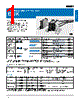
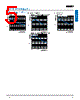
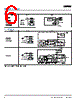
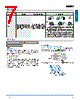
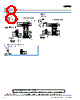
️· Purpose: The E3JK series is a range of photoelectric sensors used for object detection. They are designed for various applications involving automated processes.
️· Types: The series includes Through-beam, Retroreflective, and Diffuse-reflective models to suit different sensing scenarios.
️· Sensing Range: The document mentions sensing distances ranging from a few millimeters to several meters (though specific distances depend on model and conditions).
️· Power Reset Time: It's crucial to ensure the sensor is powered *before* the load, as it requires around 200ms to be ready for object detection.
2. Models and Output Options
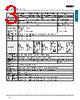
The document covers several output configurations. Here's a summarized table:
| Model Type | Output Circuit | Description | Key Features/Notes |
|---|---|---|---|
| Through-beam | Relay Output (e.g., E3JK-5M1, E3JK-R2M1) | Outputs a contact closure. | Light indicator (red) to indicate state. Polarity optional in power connection. |
| DC Transistor Output (e.g., E3JK-R2S3) | Outputs a transistor signal. | Requires an external power source for the load. | |
| Retroreflective | Same as Through-beam options | Uses a reflector for sensing. | Requires careful alignment of the reflector and sensor. |
| Diffuse-reflective | Same as Through-beam options | Detects objects without a reflector, relying on reflected light. | Sensitivity adjustment is more crucial for this type. |
1. General Overview
️· Purpose: The E3JK series is a range of photoelectric sensors used for object detection. They are designed for various applications involving automated processes.
️· Types: The series includes Through-beam, Retroreflective, and Diffuse-reflective models to suit different sensing scenarios.
️· Sensing Range: The document mentions sensing distances ranging from a few millimeters to several meters (though specific distances depend on model and conditions).
️· Power Reset Time: It's crucial to ensure the sensor is powered *before* the load, as it requires around 200ms to be ready for object detection.
2. Models and Output Options
The document covers several output configurations. Here's a summarized table:
| Model Type | Output Circuit | Description | Key Features/Notes |
|---|---|---|---|
| Through-beam | Relay Output (e.g., E3JK-5M1, E3JK-R2M1) | Outputs a contact closure. | Light indicator (red) to indicate state. Polarity optional in power connection. |
| DC Transistor Output (e.g., E3JK-R2S3) | Outputs a transistor signal. | Requires an external power source for the load. | |
| Retroreflective | Same as Through-beam options | Uses a reflector for sensing. | Requires careful alignment of the reflector and sensor. |
| Diffuse-reflective | Same as Through-beam options | Detects objects without a reflector, relying on reflected light. | Sensitivity adjustment is more crucial for this type. |
| Part No. | E3JK-R2R3 |
| Manufacturer | OMRON |
| Size | 1Mb |
| Pages | 8 pages |
| Description | All voltage photoelectric sensors |
| Does ALLDATASHEET help your business so far? [ DONATE ] |
About Alldatasheet | Advertisement | Contact us | Privacy Policy | Link to Datasheet | Link Exchange | Manufacturer List All Rights Reserved©Alldatasheet.com |
| Russian : Alldatasheetru.com | Korean : Alldatasheet.co.kr | Spanish : Alldatasheet.es | French : Alldatasheet.fr | Italian : Alldatasheetit.com Portuguese : Alldatasheetpt.com | Polish : Alldatasheet.pl | Vietnamese : Alldatasheet.vn Indian : Alldatasheet.in | Mexican : Alldatasheet.com.mx | British : Alldatasheet.co.uk | New Zealand : Alldatasheet.co.nz |
|
Family Site : ic2ic.com |
icmetro.com |
 New Zealand ▼
  English
 Chinese
 German
 Japanese
 Russian
 Korean
 Spanish
 French
 Italian
 Portuguese
 Polish
 Vietnamese
 Indian
 Mexican
 British