 |
Electronic Components Datasheet Search |
|
|
Electronic Components Datasheet Search |
|
The question interval is too short.
Please try again in a few seconds.

Hello, Please ask a question about AXP221 Datasheet
# Example questions:
➢ What is the typical charge current (ichrg) for the battery charger?
➢ What is the typical oscillator frequency (fosc) for the dcdc converters?
➢ What is the voltage range for the ips™ output voltage (vout)?
| Part No. | AXP221 |
| Manufacturer | ETC2 |
| Size | 2Mb |
| Pages | 52 pages |
| Description | PMIC Optimized For Multi-Core High-Performance System |






1. Overview & Purpose
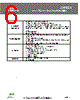
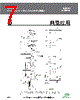
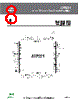
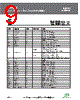
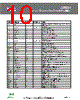
️· The AXP221 is a power management IC (PMIC) designed for battery-powered devices. It provides a comprehensive suite of power management features, including battery charging, DC-DC conversion, and power distribution. It's likely intended for mobile devices, wearables, or similar applications.
2. Key Features (Inferred from Data)
Based on the datasheet content, the AXP221 offers the following key features:
️· Multiple DC-DC Converters: It has five separate DC-DC converters (DCDC1-DCDC5), allowing for different voltage rails for different components within the device. The voltage ranges provided for each are specific.
️· Battery Charger: Includes battery charging circuitry with trickle charge, constant current (CC), and constant voltage (CV) phases. It incorporates safety features like a charge termination timer.
️· Voltage Input Handling: Accepts inputs from ACIN and VBUS, with under-voltage lockout (UVLO) protection.
️· NTC Temperature Sensing: Supports an NTC thermistor for temperature compensation and thermal protection.
️· Power Distribution: Provides regulated output voltages for various components.
️· Low Power Modes: Includes a low-power off mode to minimize battery drain.
️· Protection Features: Features such as current limiting, over-voltage protection, and short-circuit protection are implied but not explicitly detailed.
️· I2C Communication: Implied via the “P2WI” (possibly Power Protocol Watchdog Interface), which suggests I2C communication for configuration and monitoring.
3. Electrical Characteristics (Key Values)
️· Input Voltages:
- ACIN: 3.8V - 6.3V
- VBUS: 3.8V - 6.3V
️· Battery Charging:
- Target Voltage (VTRGT): 4.2V (+/- 0.5%)
- Charge Current (ICHRG): 1200 - 2200 mA
️· Output Voltages: Ranges provided for each DCDC converter. The DCDC5 has a range of 1.0V - 2.55V.
️· Current Limits: Specific current limits are provided for each DC-DC converter's PMOS switch.
️· Quiescent Current: Very low quiescent current in off mode (35 μA at 3.8V battery voltage).
️· Logic Levels: Logic low input voltage (VIL) = 0.3V, Logic High Input Voltage (VIH) = 1.5V
4. Specific Converter Details:
️· DCDC1: Primarily intended for a core processor or other major functional block.
️· DCDC2: Higher current output, suggesting usage for power-hungry components.
️· DCDC3 & DCDC4: Likely for smaller voltage rails.
️· DCDC5: Possibly used for powering an LCD or similar display.
5. Summary of Limitations and What's Missing
️· Lack of Detailed Diagrams: The datasheet lacks circuit diagrams or block diagrams of the internal architecture.
️· Timing Specifications: While I2C is implied, there are no details about timing parameters for the I2C interface.
️· Detailed Protection Mechanisms: While protection is implied (over-voltage, short-circuit, etc.), the specifics are not listed.
️· Register Map: For configuration, a register map would be essential.
️· Application Notes: Application examples and suggested component choices are absent.
To better understand how to use the AXP221, you would need a more complete datasheet. This excerpt primarily focuses on electrical specifications.
1. Overview & Purpose
️· The AXP221 is a power management IC (PMIC) designed for battery-powered devices. It provides a comprehensive suite of power management features, including battery charging, DC-DC conversion, and power distribution. It's likely intended for mobile devices, wearables, or similar applications.
2. Key Features (Inferred from Data)
Based on the datasheet content, the AXP221 offers the following key features:
️· Multiple DC-DC Converters: It has five separate DC-DC converters (DCDC1-DCDC5), allowing for different voltage rails for different components within the device. The voltage ranges provided for each are specific.
️· Battery Charger: Includes battery charging circuitry with trickle charge, constant current (CC), and constant voltage (CV) phases. It incorporates safety features like a charge termination timer.
️· Voltage Input Handling: Accepts inputs from ACIN and VBUS, with under-voltage lockout (UVLO) protection.
️· NTC Temperature Sensing: Supports an NTC thermistor for temperature compensation and thermal protection.
️· Power Distribution: Provides regulated output voltages for various components.
️· Low Power Modes: Includes a low-power off mode to minimize battery drain.
️· Protection Features: Features such as current limiting, over-voltage protection, and short-circuit protection are implied but not explicitly detailed.
️· I2C Communication: Implied via the “P2WI” (possibly Power Protocol Watchdog Interface), which suggests I2C communication for configuration and monitoring.
3. Electrical Characteristics (Key Values)
️· Input Voltages:
- ACIN: 3.8V - 6.3V
- VBUS: 3.8V - 6.3V
️· Battery Charging:
- Target Voltage (VTRGT): 4.2V (+/- 0.5%)
- Charge Current (ICHRG): 1200 - 2200 mA
️· Output Voltages: Ranges provided for each DCDC converter. The DCDC5 has a range of 1.0V - 2.55V.
️· Current Limits: Specific current limits are provided for each DC-DC converter's PMOS switch.
️· Quiescent Current: Very low quiescent current in off mode (35 μA at 3.8V battery voltage).
️· Logic Levels: Logic low input voltage (VIL) = 0.3V, Logic High Input Voltage (VIH) = 1.5V
4. Specific Converter Details:
️· DCDC1: Primarily intended for a core processor or other major functional block.
️· DCDC2: Higher current output, suggesting usage for power-hungry components.
️· DCDC3 & DCDC4: Likely for smaller voltage rails.
️· DCDC5: Possibly used for powering an LCD or similar display.
5. Summary of Limitations and What's Missing
️· Lack of Detailed Diagrams: The datasheet lacks circuit diagrams or block diagrams of the internal architecture.
️· Timing Specifications: While I2C is implied, there are no details about timing parameters for the I2C interface.
️· Detailed Protection Mechanisms: While protection is implied (over-voltage, short-circuit, etc.), the specifics are not listed.
️· Register Map: For configuration, a register map would be essential.
️· Application Notes: Application examples and suggested component choices are absent.
To better understand how to use the AXP221, you would need a more complete datasheet. This excerpt primarily focuses on electrical specifications.
| Part No. | AXP221 |
| Manufacturer | ETC2 |
| Size | 2Mb |
| Pages | 52 pages |
| Description | PMIC Optimized For Multi-Core High-Performance System |
| Does ALLDATASHEET help your business so far? [ DONATE ] |
About Alldatasheet | Advertisement | Contact us | Privacy Policy | Link to Datasheet | Link Exchange | Manufacturer List All Rights Reserved©Alldatasheet.com |
| Russian : Alldatasheetru.com | Korean : Alldatasheet.co.kr | Spanish : Alldatasheet.es | French : Alldatasheet.fr | Italian : Alldatasheetit.com Portuguese : Alldatasheetpt.com | Polish : Alldatasheet.pl | Vietnamese : Alldatasheet.vn Indian : Alldatasheet.in | Mexican : Alldatasheet.com.mx | British : Alldatasheet.co.uk | New Zealand : Alldatasheet.co.nz |
|
Family Site : ic2ic.com |
icmetro.com |
 New Zealand ▼
  English
 Chinese
 German
 Japanese
 Russian
 Korean
 Spanish
 French
 Italian
 Portuguese
 Polish
 Vietnamese
 Indian
 Mexican
 British