 |
Electronic Components Datasheet Search |
|
|
Electronic Components Datasheet Search |
|
The question interval is too short.
Please try again in a few seconds.

Hello, Please ask a question about R7ML-RS4-R Datasheet
# Example questions:
➢ Describe the data allocation within the 'data_rwa (50h)' command for an analog 4-point input unit. what information is contained in bytes 15 and 16?
➢ How is the echo back of set values handled during communication using commands like 'data_rwa (50h)' for both input and output data?
➢ What is the range of data that can be represented with the analog input conversion, and what values indicate overrange conditions?
| Part No. | R7ML-RS4-R |
| Manufacturer | MSYSTEM |
| Size | 1Mb |
| Pages | 40 pages |
| Description | Remote I/O R7 Series MECHATROLINK I/O MODULE |

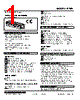
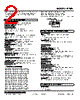
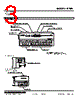
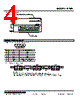
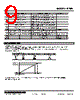
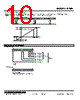
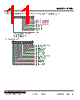
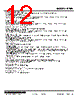
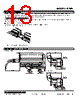
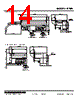
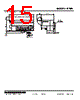
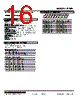
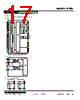
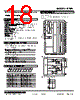
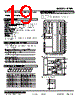
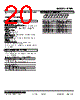
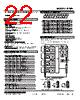
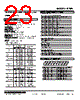
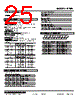
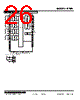
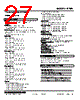
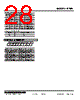
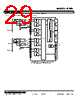
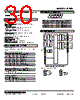
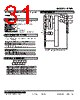
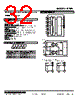
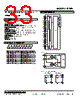
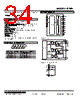
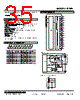
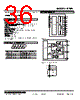
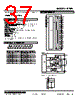
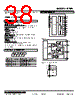
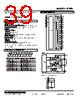

Overall, the document describes the R7ML, a module for industrial automation, likely part of a larger system.
1. Core Functionality & Communication
️· Purpose: The R7ML module is designed for industrial automation, allowing communication and data exchange with a central controller.
️· Protocol: The document uses terminology like "master" and "slave" suggesting a master-slave communication architecture. The exact protocol isn's specified but this implies a defined communication protocol is in place.
️· Data Transmission: The module supports Discrete I/O (inputs and outputs), Analog Input, and Analog Output. It appears to be capable of sending data to the "master" and receiving commands/data from it.
2. Data Handling & Conversion
️· Analog Input:
- Input range is typically 0-5V DC.
- Overrange input is handled, limiting values to -15% and +115% of the nominal range.
- Input values are converted into a percentage (0-100%) and then to a 16-bit decimal/hexadecimal representation. (e.g., 0% = 0, 100% = 10000 in decimal or 2710 in hex.)
️· Analog Output: Conversion works in the reverse order of input (analog voltage converted to a proportional digital value).
️· Discrete I/O: The module utilizes discrete inputs and outputs for on/off signaling.
3. Specific Commands & Data Structures (Crucial for Communication)
The document details several commands (like `DATA_RWA` for data read/write) and explains the *structure* of the data transmitted with each command. Understanding this is *essential* for programming or configuring the R7ML:
️· DATA_RWA (50H): This is a major command. The data layout within the command block is defined specifically for different I/O types (Discrete, Analog). Pay close attention to:
- Byte locations for input/output data (low byte, high byte).
- Byte locations for extension module data.
- Byte locations for status information.
- "Echo back" areas - where the module returns the data that was set.
️· LC2 Command: The description indicates a set of data related to a set of inputs - a "set data" and a "displayed value" - likely used for configuration or monitoring.
️· Other Commands: The document references commands like `CONNECT` (implied by the communication architecture) and `RESET` (which is a standard system reset).
4. Data Types
️· Discrete I/O: Basic on/off signals.
️· Analog Input: Voltage (0-5V DC) converted to proportional digital values.
️· Analog Output: Voltage (0-5V DC) driven by digital values.
Important Notes & What's Missing:
️· Communication Protocol: The exact communication protocol used is *not* explicitly stated. It's implied to be some defined protocol that uses these specific command structures.
️· Addressing: There's no mention of how to address individual R7ML modules on a network.
️· Configuration: The document doesn’t detail the specifics of how to configure the R7ML (e.g., setting scaling ranges for analog inputs, assigning I/O addresses).
️· Error Handling: There's no mention of error handling or status codes.
To effectively use the information, you's need:
️· The full protocol specification.
️· A detailed configuration guide.
️· A programming guide with examples.
️· A hardware connection guide
Overall, the document describes the R7ML, a module for industrial automation, likely part of a larger system.
1. Core Functionality & Communication
️· Purpose: The R7ML module is designed for industrial automation, allowing communication and data exchange with a central controller.
️· Protocol: The document uses terminology like "master" and "slave" suggesting a master-slave communication architecture. The exact protocol isn's specified but this implies a defined communication protocol is in place.
️· Data Transmission: The module supports Discrete I/O (inputs and outputs), Analog Input, and Analog Output. It appears to be capable of sending data to the "master" and receiving commands/data from it.
2. Data Handling & Conversion
️· Analog Input:
- Input range is typically 0-5V DC.
- Overrange input is handled, limiting values to -15% and +115% of the nominal range.
- Input values are converted into a percentage (0-100%) and then to a 16-bit decimal/hexadecimal representation. (e.g., 0% = 0, 100% = 10000 in decimal or 2710 in hex.)
️· Analog Output: Conversion works in the reverse order of input (analog voltage converted to a proportional digital value).
️· Discrete I/O: The module utilizes discrete inputs and outputs for on/off signaling.
3. Specific Commands & Data Structures (Crucial for Communication)
The document details several commands (like `DATA_RWA` for data read/write) and explains the *structure* of the data transmitted with each command. Understanding this is *essential* for programming or configuring the R7ML:
️· DATA_RWA (50H): This is a major command. The data layout within the command block is defined specifically for different I/O types (Discrete, Analog). Pay close attention to:
- Byte locations for input/output data (low byte, high byte).
- Byte locations for extension module data.
- Byte locations for status information.
- "Echo back" areas - where the module returns the data that was set.
️· LC2 Command: The description indicates a set of data related to a set of inputs - a "set data" and a "displayed value" - likely used for configuration or monitoring.
️· Other Commands: The document references commands like `CONNECT` (implied by the communication architecture) and `RESET` (which is a standard system reset).
4. Data Types
️· Discrete I/O: Basic on/off signals.
️· Analog Input: Voltage (0-5V DC) converted to proportional digital values.
️· Analog Output: Voltage (0-5V DC) driven by digital values.
Important Notes & What's Missing:
️· Communication Protocol: The exact communication protocol used is *not* explicitly stated. It's implied to be some defined protocol that uses these specific command structures.
️· Addressing: There's no mention of how to address individual R7ML modules on a network.
️· Configuration: The document doesn’t detail the specifics of how to configure the R7ML (e.g., setting scaling ranges for analog inputs, assigning I/O addresses).
️· Error Handling: There's no mention of error handling or status codes.
To effectively use the information, you's need:
️· The full protocol specification.
️· A detailed configuration guide.
️· A programming guide with examples.
️· A hardware connection guide
| Part No. | R7ML-RS4-R |
| Manufacturer | MSYSTEM |
| Size | 1Mb |
| Pages | 40 pages |
| Description | Remote I/O R7 Series MECHATROLINK I/O MODULE |
| Does ALLDATASHEET help your business so far? [ DONATE ] |
About Alldatasheet | Advertisement | Contact us | Privacy Policy | Link to Datasheet | Link Exchange | Manufacturer List All Rights Reserved©Alldatasheet.com |
| Russian : Alldatasheetru.com | Korean : Alldatasheet.co.kr | Spanish : Alldatasheet.es | French : Alldatasheet.fr | Italian : Alldatasheetit.com Portuguese : Alldatasheetpt.com | Polish : Alldatasheet.pl | Vietnamese : Alldatasheet.vn Indian : Alldatasheet.in | Mexican : Alldatasheet.com.mx | British : Alldatasheet.co.uk | New Zealand : Alldatasheet.co.nz |
|
Family Site : ic2ic.com |
icmetro.com |
 New Zealand ▼
  English
 Chinese
 German
 Japanese
 Russian
 Korean
 Spanish
 French
 Italian
 Portuguese
 Polish
 Vietnamese
 Indian
 Mexican
 British