 |
Electronic Components Datasheet Search |
|
|
Electronic Components Datasheet Search |
|
The question interval is too short.
Please try again in a few seconds.

Hello, Please ask a question about AX88170L Datasheet
# Example questions:
➢ What is the purpose of the 'mdc' signal?
➢ What type of signal is 'mdio' (input, output, or input/output) and what is its function?
➢ When are txd[3:0] signals accepted for transmission by the phy?
| Part No. | AX88170L |
| Manufacturer | ASIX |
| Size | 316 Kbytes |
| Pages | 39 pages |
| Description | USB to Fast Ethernet/HomePNA Controller |

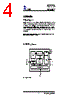



Okay, I'm going to attempt to summarize the information you've provided. This is a bit challenging because the content appears to be a fragmented section of a datasheet or technical document, and there are some repeating elements. I'll focus on extracting the key points and organizing them.
Overall Context:
This excerpt describes the MII (Media Independent Interface) pins used within an integrated circuit (likely a network interface controller or similar device). The MII is a standard interface that allows the device to communicate with a PHY (Physical Layer) chip that handles the actual transmission and reception of data over a physical medium (like Ethernet cable).
Key Information:
1. Interface Type: MII (Media Independent Interface).
2. Purpose: To connect the integrated circuit to a PHY chip. The PHY handles the physical transmission and reception of data.
3. Pin Descriptions (with pins):
- TXD[3:0]: Transmit Data. These are 4 data lines used to send data from the integrated circuit *to* the PHY. Each `TXD[i]` represents a single bit of data.
- TX_CLK: Transmit Clock. This clock signal is used to synchronize the transmission of data from the integrated circuit to the PHY. It's generated by the integrated circuit.
- MDC: Management Data Clock. This clock signal is used for management and control operations between the integrated circuit and the PHY. It's a lower frequency clock used for configuration and status updates.
- MDIO: Management Data Input/Output. This is a bidirectional data line used for the management and control operations with the PHY.
Important Considerations (based on the data):
️· Data Synchronization: `TX_CLK` is crucial for synchronized data transfer.
️· Management/Configuration: `MDC` and `MDIO` are used for configuring the PHY and reading its status. These are not involved in regular data transmission.
️· Bidirectional Nature: While `TXD[3:0]` and `TX_CLK` are primarily for transmitting data *from* the IC *to* the PHY, `MDIO` is a bidirectional signal.
Limitations of this summary:
️· Incomplete Picture: This is just a snippet. A full datasheet would have more detail about the timing, voltage levels, and other electrical characteristics of these signals.
️· Repetitions: The repeated table segments suggest this information might have been extracted from a larger document.
To help me further refine this summary, could you tell me:
* What is the specific device this datasheet refers to?
* What are you trying to understand about this interface?
Overall Context:
This excerpt describes the MII (Media Independent Interface) pins used within an integrated circuit (likely a network interface controller or similar device). The MII is a standard interface that allows the device to communicate with a PHY (Physical Layer) chip that handles the actual transmission and reception of data over a physical medium (like Ethernet cable).
Key Information:
1. Interface Type: MII (Media Independent Interface).
2. Purpose: To connect the integrated circuit to a PHY chip. The PHY handles the physical transmission and reception of data.
3. Pin Descriptions (with pins):
- TXD[3:0]: Transmit Data. These are 4 data lines used to send data from the integrated circuit *to* the PHY. Each `TXD[i]` represents a single bit of data.
- TX_CLK: Transmit Clock. This clock signal is used to synchronize the transmission of data from the integrated circuit to the PHY. It's generated by the integrated circuit.
- MDC: Management Data Clock. This clock signal is used for management and control operations between the integrated circuit and the PHY. It's a lower frequency clock used for configuration and status updates.
- MDIO: Management Data Input/Output. This is a bidirectional data line used for the management and control operations with the PHY.
Important Considerations (based on the data):
️· Data Synchronization: `TX_CLK` is crucial for synchronized data transfer.
️· Management/Configuration: `MDC` and `MDIO` are used for configuring the PHY and reading its status. These are not involved in regular data transmission.
️· Bidirectional Nature: While `TXD[3:0]` and `TX_CLK` are primarily for transmitting data *from* the IC *to* the PHY, `MDIO` is a bidirectional signal.
Limitations of this summary:
️· Incomplete Picture: This is just a snippet. A full datasheet would have more detail about the timing, voltage levels, and other electrical characteristics of these signals.
️· Repetitions: The repeated table segments suggest this information might have been extracted from a larger document.
| Part No. | AX88170L |
| Manufacturer | ASIX |
| Size | 316 Kbytes |
| Pages | 39 pages |
| Description | USB to Fast Ethernet/HomePNA Controller |
| Does ALLDATASHEET help your business so far? [ DONATE ] |
About Alldatasheet | Advertisement | Contact us | Privacy Policy | Link to Datasheet | Link Exchange | Manufacturer List All Rights Reserved©Alldatasheet.com |
| Russian : Alldatasheetru.com | Korean : Alldatasheet.co.kr | Spanish : Alldatasheet.es | French : Alldatasheet.fr | Italian : Alldatasheetit.com Portuguese : Alldatasheetpt.com | Polish : Alldatasheet.pl | Vietnamese : Alldatasheet.vn Indian : Alldatasheet.in | Mexican : Alldatasheet.com.mx | British : Alldatasheet.co.uk | New Zealand : Alldatasheet.co.nz |
|
Family Site : ic2ic.com |
icmetro.com |
 New Zealand ▼
  English
 Chinese
 German
 Japanese
 Russian
 Korean
 Spanish
 French
 Italian
 Portuguese
 Polish
 Vietnamese
 Indian
 Mexican
 British