|
Electronic Components Datasheet Search |
|
|
Electronic Components Datasheet Search |
|
STM32G47PBY3XXX Datasheet(PDF) 27 Page - STMicroelectronics |
|
|
|||||||||||||||||||||||||||||
STM32G47PBY3XXX Datasheet(HTML) 27 Page - STMicroelectronics |
|
|
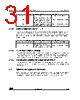
27 / 229 page  DS12712 Rev 3 27/229 STM32G473xB STM32G473xC STM32G473xE Functional overview 46 3.13 Clocks and startup The clock controller distributes the clocks coming from different oscillators to the core and the peripherals. It also manages clock gating for low-power modes and ensures clock robustness. It features: • Clock prescaler: to get the best trade-off between speed and current consumption, the clock frequency to the CPU and peripherals can be adjusted by a programmable prescaler • Safe clock switching: clock sources can be changed safely on the fly in run mode through a configuration register. • Clock management: to reduce power consumption, the clock controller can stop the clock to the core, individual peripherals or memory. • System clock source: three different sources can deliver SYSCLK system clock: – 4 - 48 MHz high-speed oscillator with external crystal or ceramic resonator (HSE). It can supply clock to system PLL. The HSE can also be configured in bypass mode for an external clock. – 16 MHz high-speed internal RC oscillator (HSI16), trimmable by software. It can supply clock to system PLL. – System PLL with maximum output frequency of 170 MHz. It can be fed with HSE or HSI16 clocks. • Auxiliary clock source: two ultra-low-power clock sources for the real-time clock (RTC): – 32.768 kHz low-speed oscillator with external crystal (LSE), supporting four drive capability modes. The LSE can also be configured in bypass mode for using an external clock. – 32 kHz low-speed internal RC oscillator (LSI) with ±5% accuracy, also used to clock an independent watchdog. • Peripheral clock sources: several peripherals (I2S, USART, I2C, LPTimer, ADC, SAI, RNG) have their own clock independent of the system clock. • Clock security system (CSS): in the event of HSE clock failure, the system clock is automatically switched to HSI16 and, if enabled, a software interrupt is generated. LSE clock failure can also be detected and generate an interrupt. • Clock-out capability: – MCO: microcontroller clock output: it outputs one of the internal clocks for external use by the application – LSCO: low speed clock output: it outputs LSI or LSE in all low-power modes. Several prescalers allow to configure the AHB frequency, the High-speed APB (APB2) and the low speed APB (APB1) domains. The maximum frequency of the AHB and the APB domains is 170 MHz. |
|
Link URL |
| Does ALLDATASHEET help your business so far? [ DONATE ] |
About Alldatasheet | Advertisement | Contact us | Privacy Policy | Link to Datasheet | Link Exchange | Manufacturer List All Rights Reserved©Alldatasheet.com |
| Russian : Alldatasheetru.com | Korean : Alldatasheet.co.kr | Spanish : Alldatasheet.es | French : Alldatasheet.fr | Italian : Alldatasheetit.com Portuguese : Alldatasheetpt.com | Polish : Alldatasheet.pl | Vietnamese : Alldatasheet.vn Indian : Alldatasheet.in | Mexican : Alldatasheet.com.mx | British : Alldatasheet.co.uk | New Zealand : Alldatasheet.co.nz |
|
Family Site : ic2ic.com |
icmetro.com |
 New Zealand ▼
 English
 Chinese
 German
 Japanese
 Russian
 Korean
 Spanish
 French
 Italian
 Portuguese
 Polish
 Vietnamese
 Indian
 Mexican
 British
 New Zealand