|
Electronic Components Datasheet Search |
|
|
Electronic Components Datasheet Search |
|
PIC16F7X7 Datasheet(PDF) 190 Page - Microchip Technology |
|
|
|||||||||||||||||||||||||||||
PIC16F7X7 Datasheet(HTML) 190 Page - Microchip Technology |
|
|
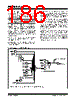
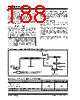
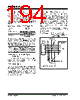
190 / 276 page  PIC16F7X7 DS30498C-page 188 2004 Microchip Technology Inc. 15.17.3 TWO-SPEED CLOCK START-UP MODE Two-Speed Start-up minimizes the latency between oscillator start-up and code execution that may be selected with the IESO (Internal/External Switchover) bit in Configuration Word Register 2. This mode is achieved by initially using the INTRC for code execution until the primary oscillator is stable. If this mode is enabled and any of the following condi- tions exist, the system will begin execution with the INTRC oscillator. This results in almost immediate code execution with a minimum of delay. • POR and after the Power-up Timer has expired (if PWRTEN = 0) • or following a wake-up from Sleep • or a Reset, when running from T1OSC or INTRC (after a Reset, SCS<1:0> are always set to ‘00’). If the primary oscillator is configured to be anything other than XT, LP or HS, then Two-Speed Start-up is disabled because the primary oscillator will not require any time to become stable after POR or an exit from Sleep. If the IRCF bits of the OSCCON register are configured to a non-zero value prior to entering Sleep mode, the secondary system clock frequency will come from the output of the INTOSC. The IOFS bit in the OSCCON register will be clear until the INTOSC is stable. This will allow the user to determine when the internal oscillator can be used for time critical applications. Checking the state of the OSTS bit will confirm whether the primary clock configuration is engaged. If not, the OSTS bit will remain clear. When the device is auto-configured in INTRC mode following a POR or wake-up from Sleep, the rules for entering other oscillator modes still apply, meaning the SCS<1:0> bits in OSCCON can be modified before the OST time-out has occurred. This would allow the application to wake-up from Sleep, perform a few instructions using the INTRC as the clock source and go back to Sleep without waiting for the primary oscillator to become stable. 15.17.3.1 Two-Speed Start-up Sequence 1. Wake-up from Sleep, Reset or POR. 2. OSCON bits configured to run from INTRC (31.25 kHz). 3. Instructions begin execution by INTRC (31.25 kHz). 4. OST enabled to count 1024 clock cycles. 5. OST timed out, wait for falling edge of INTRC. 6. OSTS is set. 7. System clock held low for eight falling edges of new clock (LP, XT or HS). 8. System clock is switched to primary source (LP, XT or HS). The software may read the OSTS bit to determine when the switchover takes place so that any software timing edges can be adjusted. FIGURE 15-13: TWO-SPEED START-UP Note: Following any Reset, the IRCF bits are zeroed and the frequency selection is forced to 31.25 kHz. The user can modify the IRCF bits to select a higher internal oscillator frequency. Note: Executing a SLEEP instruction will abort the oscillator start-up time and will cause the OSTS bit to remain clear. Q4 Q1 Q3 Q4 Q1 Q2 OSC1 Sleep Program PC 0000h INTRC TOST Q3 Q4 OSC2 OSTS System Clock 0001h Q1 Q2 Q3 Q4 Q1 Q2 Counter 0004h 0005h 0003h Q1 Q2 Q3 Q4 CPU Start-up |
|
Link URL |
| Does ALLDATASHEET help your business so far? [ DONATE ] |
About Alldatasheet | Advertisement | Contact us | Privacy Policy | Link to Datasheet | Link Exchange | Manufacturer List All Rights Reserved©Alldatasheet.com |
| Russian : Alldatasheetru.com | Korean : Alldatasheet.co.kr | Spanish : Alldatasheet.es | French : Alldatasheet.fr | Italian : Alldatasheetit.com Portuguese : Alldatasheetpt.com | Polish : Alldatasheet.pl | Vietnamese : Alldatasheet.vn Indian : Alldatasheet.in | Mexican : Alldatasheet.com.mx | British : Alldatasheet.co.uk | New Zealand : Alldatasheet.co.nz |
|
Family Site : ic2ic.com |
icmetro.com |
 New Zealand ▼
 English
 Chinese
 German
 Japanese
 Russian
 Korean
 Spanish
 French
 Italian
 Portuguese
 Polish
 Vietnamese
 Indian
 Mexican
 British
 New Zealand